The Two-Minute Pause That Helps a Detail Stay Noticeable
A two-minute pause for noticing details helps you catch one clear feature of a new scene without writing everything down or forcing an interpretation.
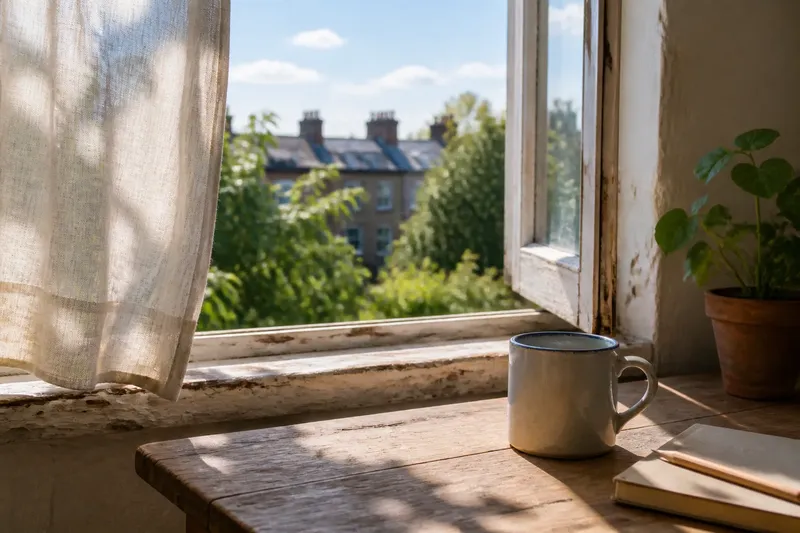
What do you do when a new scene catches your attention, but you cannot say exactly why? Try a two-minute pause for noticing details: stay with what is in front of you long enough to pick out one specific feature, without reaching for a notebook or deciding what it means. The point is not to inspect everything. It is to give a small, fresh impression a little room to become clear.
Why the pause helps
A first impression arrives in a bundle. You might register a bright colour, an odd shape, a faint sound and a passing mood all at once. Then your attention moves on, often carrying only a loose label such as “interesting” or “strange”. A brief pause gives the bundle time to separate into parts.
That separation matters because a detail is easier to return to than a general impression. “A cup” is broad; “a chipped blue rim beside the handle” gives your attention something definite to hold. You do not need to collect every feature or make a polished description. One clear observation is enough to make the encounter more distinct.
Use the pause after something has already caught your eye or ear: a doorway, a phrase in conversation, a leaf caught against a kerb, or a change in the light on a wall. It is not a hunt for something remarkable. Ordinary things are useful because they give you room to notice what your first glance skipped.
Choose a small subject
Begin by letting one thing claim your attention. Pick an object or scene that is already nearby rather than searching for a perfect subject. A spoon on a table, a bus window fogged at the edge, or a coat hanging with one sleeve turned inside out will do.
Keep the subject narrow enough that you can hold it in mind without scanning the whole room. If you choose a busy shop, attend to one shelf, one sign or one sound rather than the entire place. If the scene changes quickly, such as people crossing a station concourse, choose one brief feature you can observe safely from where you are.
Say, “Imagine you have just noticed a small paper label curling away from a jar in the kitchen.” The starting point is that one label, not the whole kitchen. You stay with it for the pause, notice that one corner lifts while the rest lies flat, then carry away that single detail. The expected result is a more specific impression of the jar than the vague thought that something on the counter looked untidy.
Settle without recording
Once you have chosen, stop moving towards the next thing for a moment. Stand or sit comfortably, and let your gaze rest on the subject. You can remain aware of your surroundings; there is no need to stare, close your eyes or withdraw from what is happening around you.
Give the pause a simple boundary. You might count slowly to a number that feels like roughly two minutes, use the changing light on a nearby surface as a loose marker, or wait through a short quiet stretch in your walk. A timer is optional, and a phone can stay in your pocket. If the moment is interrupted, resume only if it feels natural; the practice should fit the setting, not compete with it.
During the pause, do not take notes, make a voice memo or compose a full description in your head. Those actions can be useful elsewhere, but here they shift the task from noticing to capturing. Let the subject remain where it is, and allow your attention to return when it wanders.
Use one observation prompt
Ask one plain question: What is one specific thing I can see or hear now that I did not register at first? The wording invites a fresh detail without demanding a clever answer. Choose a feature you can point to, describe or locate, rather than a judgement about whether the subject is beautiful, useful or significant.
If the answer does not arrive at once, try moving your attention across a few simple qualities:
- Edge: Is a line straight, worn, jagged, folded or softened?
- Surface: Does it look smooth, grainy, damp, dusty or uneven?
- Colour: Is there a small shift, patch or contrast you missed?
- Sound: Is a noise steady, broken, near, distant or changing?
- Position: What sits beside, beneath, behind or slightly apart from the main subject?
- Movement: Does something tremble, drift, settle or repeat?
These are prompts, not a checklist to complete. Pick the one that fits what is in front of you and leave the rest alone. A curtain moving near a cracked window may offer a small shift in its hem; a quiet café may offer the clink that follows a cup being set down. There is no need to turn either moment into a story.
Stop at one clear detail
When a specific feature becomes noticeable, pause there. Notice its shape, location or quality once more, then stop searching. The exercise is complete when you can recall the detail plainly, not when you have exhausted every possible observation.
It can be tempting to ask why the detail matters, what it symbolises or how it might become an idea. Leave those questions for another time. Interpretation can crowd out the simple distinction you have just made between, say, a wall and the thin line where its paint has peeled. For this pause, noticing comes before explaining.
If several details arrive together, choose the one that feels easiest to name and let the others pass. That choice is not a claim that it is the most important feature. It is simply a way to give the practice a clean ending instead of turning it into an inventory.
Carry the impression lightly
After the pause, return to what you were doing. You do not owe the moment a record, a drawing or a finished idea. If the detail remains with you, let it come along; if it fades, the noticing still happened. The value lies in having attended to something specific, not in producing an artefact each time.
Later, you may choose to use the detail in a sketch, a sentence, a conversation or a design. Keep that choice separate from the pause itself. The two-minute practice is most useful when it does not demand an outcome, leaving you free to decide whether the observation belongs anywhere else.
Questions about noticing?
What if nothing stands out?
Stay with the subject and use one of the simple prompts, such as edge, surface or position. If no detail becomes clear, end the pause without forcing one; the next encounter may offer a more natural point of focus.
Does the pause need to last exactly two minutes?
No. Two minutes is a gentle boundary that keeps the practice short, not a precise rule. Use a shorter pause when the setting is busy or your attention is needed elsewhere.
Should I write down what I noticed?
Not during this exercise. The pause is for direct attention, and a note is optional later if you have a genuine reason to keep the detail.
Can I use this with a sound or a memory?
Use it with a sound you can hear now, such as a kettle’s low hum or footsteps changing on a different floor. A memory is less suitable because the prompt is about attending to a present detail rather than rebuilding an event from recollection.
A two-minute pause for noticing details does not ask you to become more observant all day; it gives one encounter a small, workable boundary. The next time something catches your attention, stay with one part of it, ask what you did not register at first, and leave with just that. One accurately noticed feature is plenty to carry into the rest of your day.