How People Kept Idea Collections Before the Modern Notebook
Idea collections before modern notebooks ranged from commonplace books to card files. Learn what each format made easier and choose one for your own notes.
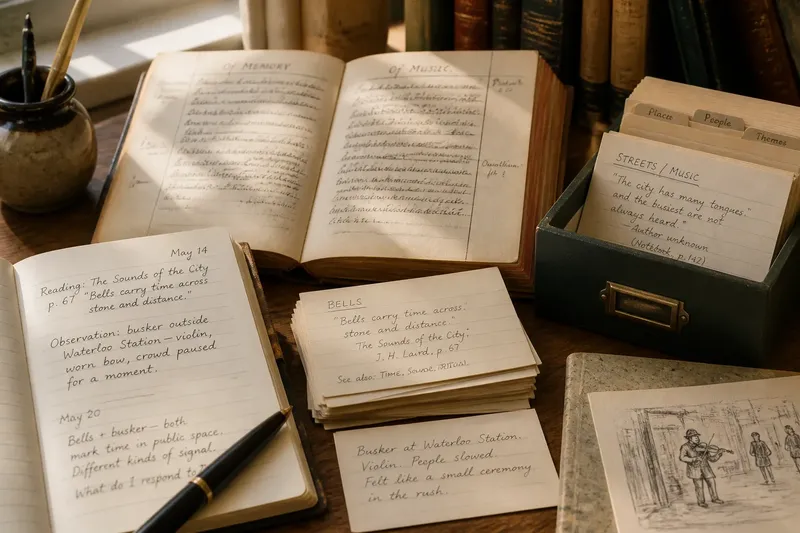
How did people keep idea collections before the modern notebook became a familiar place for private notes? A commonplace book, a printed book with blank pages, a bundle of slips and a card file each offered different ways to preserve and retrieve material. Their history is not a single progression: practices varied by period, place and purpose.
That history can clarify a choice you face now. A book keeps entries together, while loose slips make them movable; a journal preserves the order in which thoughts developed. Looking at the formats in their specific contexts shows what each was built to do—and which kind of return it can support today.
Commonplace books
In early modern Europe, commonplace books were used to gather excerpts and observations under topics or headings. The practice drew on the older rhetorical idea of loci communes, or commonplaces: recurring subjects and lines of argument that readers could consult when composing or speaking. A commonplace book was not simply a diary, and it did not have one fixed layout.
Some readers copied passages into blank books and grouped them by subject; others used headings, indexes or marginal marks to find material again. The arrangement depended on the owner’s needs and the book’s design. A passage might be copied with a source reference, a comment or a heading that helped the reader retrieve it later.
Printed books could also invite annotation and collection. In parts of Europe during the sixteenth and seventeenth centuries, printers issued books with blank spaces or pages intended for readers’ notes. These formats placed writing beside printed material, but they did not make every owner’s practice the same. The useful historical point is modest: readers adapted both blank and printed books to hold material they wanted to revisit.
For a present-day reader, this form suits selected passages that benefit from context and a stable place. Record the wording, source and subject together. A contents page or index can help when topics recur, but a bound volume makes large-scale rearrangement awkward.
Loose slips and cards
Separate slips have a different history from the commonplace book. Paper scraps and cards can be sorted independently, but the format became especially associated with organised filing systems as card catalogues and office indexing developed. Libraries used catalogue cards to represent books and help readers locate them; scholarly and administrative card files served other purposes. A private collection of ideas is not the same thing as a library catalogue, even if both rely on movable cards.
For an idea collection, each slip can hold one quotation, observation or question, with enough context to make it intelligible on its own. A heading, source note or cross-reference helps prevent a fragment from becoming an orphan when it is moved. Cards work well when you want to compare or regroup notes, but the freedom to rearrange does not itself produce a useful connection.
Paper cards make a group visible on a desk. A digital tool such as Obsidian or a plain-text folder can offer separate searchable notes and links, though those links still need clear wording and maintenance. Choose paper if physical arrangement helps you think; choose digital notes if searching and editing are more useful to you.
Journals and notebooks
A dated journal preserves sequence. Readers and writers have used diaries, notebooks and commonplace books for overlapping purposes, so the labels do not mark a clean historical boundary. A working journal is most useful when the order of thought matters: a question appears, an early response follows, and later entries show what changed.
Unlike a subject-based commonplace book, a journal can postpone decisions about where a note belongs. Unlike separate cards, it keeps an entry beside the circumstances and reactions that surrounded it. That continuity can make an evolving question easier to follow, while an index or recurring page marks can help locate themes later.
Imagine you are reading a book about city sounds and jot down a sentence about bells, then record an observation of a busker outside a station. If your main aim is to compare selected passages by theme, copy the sentence and its source into a commonplace book, then add the observation under a related heading. If you want to move the sentence beside notes about music from different places, put it on a card with its source and arrange it with those notes. If your question is how your view of public sound changes as you read, keep both entries in a dated journal and add a later response. The starting material is the same; the format changes what is easiest to revisit.
Choosing a historical format
The practical choice is not about copying an old system exactly. It is about deciding what you need the collection to preserve: subject, mobility or sequence.
- Check whether source context matters: if you need to see a quotation beside its book title and your comment, use a commonplace page; if you mainly need to compare independent fragments, use separate cards instead.
- Check whether rearrangement is central: if you expect to move notes between groups, choose cards or discrete digital notes; if you rarely change categories, a bound notebook is simpler.
- Check whether order carries meaning: if you want to trace how an idea developed, use a dated journal; if chronology is incidental, arrange entries by topic or keep them separate.
- Check how you retrieve old notes: if you search by subject, add headings or an index to a bound book; if you search by exact wording, use a searchable digital file or a clearly indexed card set.
- Check whether each fragment can stand alone: if a card makes sense without its neighbours, file it separately; if it needs the surrounding conversation or reaction, keep it in a journal entry.
- Check how much upkeep you will accept: if you will maintain an index or cross-references, a larger subject collection may remain usable; if not, keep the system small and choose a simple notebook or a few labelled groups.
Questions about formats?
What is a commonplace book?
It is a collection of selected passages and related notes, often grouped under subject headings. Early modern European readers used the form in varied ways, so no single layout defines every commonplace book.
Were commonplace books just diaries?
No. A diary usually follows events or reflections in time, while a commonplace book typically gathers material for later reference by subject or association. In practice, one book could include both kinds of writing.
Are loose cards a modern invention?
Loose paper notes are older than modern digital note systems, but card filing became particularly associated with cataloguing and administrative work. A private card collection can borrow the movable format without serving the same purpose as a library catalogue.
Which format should I use now?
Use a commonplace book for selected material grouped by subject, cards for fragments you want to rearrange, and a journal for thoughts whose sequence matters. If your needs overlap, keep one main collection and transfer only notes that clearly serve another purpose.
Keep the return useful
Whatever format you choose, include enough information for your future self to understand a fragment. For a quotation, note its source; for an observation, record what happened and where; for a question, add the subject it concerns. These small details make a collection easier to revisit without imposing an elaborate filing system.
Idea collections before modern notebooks show that the container shapes the work: books favour grouped rereading, cards allow rearrangement, and journals retain sequence. Choose the format that supports the action you expect to take next, then review it when that action changes. A collection remains useful not because it is complete, but because its notes can still be found and understood.