Questions on Paper or Questions on a Walk?
Questions on paper or questions on a walk: use a simple week-long routine to choose the setting that gives your curiosity room to notice more.
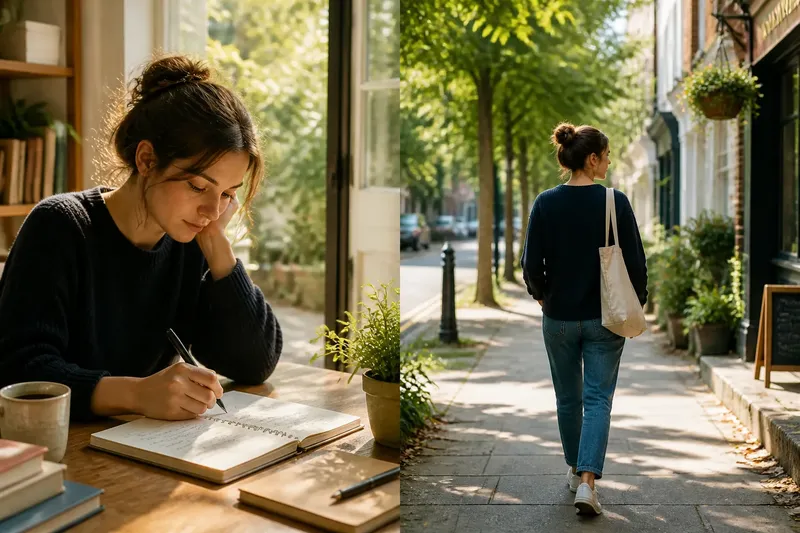
Questions on paper or questions on a walk—which suits the question you have today? A written prompt can hold your attention steady; carrying one outdoors can let the surroundings nudge it in unexpected directions. A week-long routine helps you notice which setting serves which kind of curiosity, without turning either into a test.
Two kinds of attention
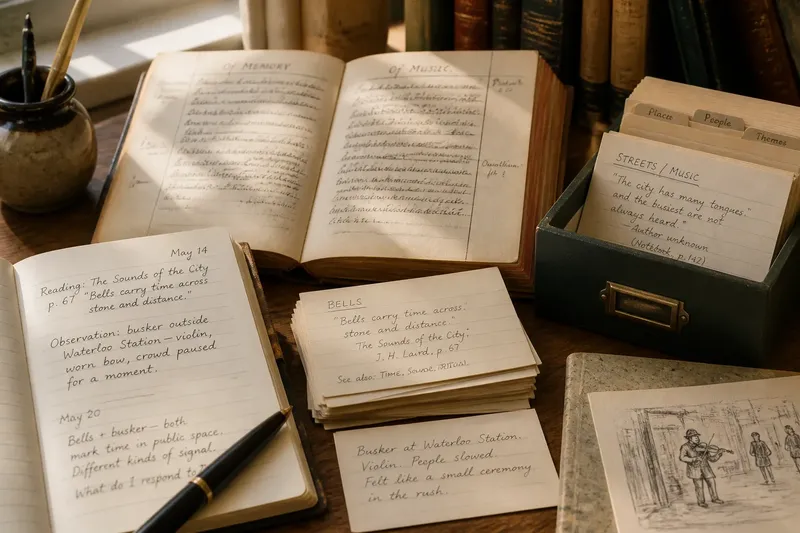
Writing a question gives it a visible shape. You can underline a word, add a second question beneath it or circle the part that feels most alive. The page is especially useful when you want to examine a tangled thought, compare possibilities or stay close to a detail that might slip away.
A walk offers a different kind of company. You carry the question in your mind while attending to what is around you: a shop sign, a change in the pavement, someone pausing at a doorway. These details do not have to answer anything. They can simply shift the angle from which you see the question.
Neither method is inherently deeper. Paper narrows and steadies attention; walking gives it room to roam. Your available time, surroundings and energy help determine which mode is useful now.
A week of questions
Choose one modest question for the week, preferably one you can hold without needing to settle it. “Why do I keep postponing the first sketch?” is more workable than a question that tries to explain your whole creative life. Keep the same wording for the first few sessions so you can notice how the setting changes your attention.
- Day one, five minutes: Write the question at the top of a page. Under it, add what you already notice, what you are unsure about and one word that seems important. Stop before you try to produce an answer.
- Day two, a short walk: Carry the question without writing it down. Notice ordinary details that catch your attention, but do not force them into a connection. When you return, jot down one detail and any change in how the question feels.
- Day three, ten minutes: Return to the page. Add two possible interpretations of the question, even if one seems unlikely. Mark the interpretation you would most like to explore, rather than the one that sounds most impressive.
- Day four, as time allows: Choose paper if you have a quiet place and a few uninterrupted minutes. Choose a walk if you can step outside safely and have room to think. If neither setting is available, write the question on a scrap of paper and revisit it when circumstances suit.
- Day five, a walk or a written session: Use the setting that felt less familiar earlier in the week. On a walk, let the question recede while you notice your surroundings; at a desk, read it once and then look away before writing.
- Day six, five minutes: Compare your notes. Circle a phrase, observation or uncertainty that appeared in one setting but not the other. Do not treat its appearance as proof; it is a useful clue about what each setting helped you notice.
- Day seven, ten minutes: Choose one small next action, such as sketching an object connected to the question or asking someone a specific, open question. Record what you want to look at next, then let the original question rest.
The routine is flexible. If a day disappears, pick up where you left off instead of trying to catch up. The point is to compare attention, not to complete a perfect sequence.
Choose by setting
Use a page when you need precision: a question has several parts, an idea keeps changing as you think, or you want to compare two interpretations. A notebook, index card or notes app can all work. Choose a format that lets you see the question and add a few words without fuss.
Take the question on a walk when you have a stretch of time and a route that leaves your attention available. A familiar street can be useful because you are not busy finding your way; a park path may offer more space to drift. Keep the question short enough to remember, and leave your phone in your pocket unless you need it for practical reasons.
Some days, the best choice is a brief combination. Write the question before leaving, carry it with you, then add one observation on your return. That gives the walk room to alter your attention while preserving a trace of what changed.
Questions readers ask?
What kind of question works on a walk?
Choose one that can stay open, such as “What makes this corner feel busy?” or “Where does this sketch lose its energy?” If the wording contains several separate problems, write it down and choose one part to carry.
Should I record thoughts during the walk?
Only if doing so feels comfortable and does not distract you from your surroundings. You can remember a single phrase or detail and write it after you stop; there is no need to capture every passing thought.
What if I cannot go outside?
Carry the question through another ordinary activity, such as walking along a corridor or looking out from a doorway. If movement is not practical, use a change of position or view as a cue to hold the question lightly.
How do I know which method to choose?
Ask what the question needs: a page for structure and comparison, or movement and surroundings for a shift of perspective. Your time matters too; a few quiet minutes may favour writing, while a longer available break may suit a walk.
Keep the useful trace
At the end of the week, keep only the notes that may help you return to the question: a changed phrase, an unexpected observation or a next action. You do not need a full account of every session. This small record makes it easier to choose a setting next time, without turning curiosity into paperwork.
For questions on paper or questions on a walk, the choice is less about finding a winning method than matching your attention to the moment. When you have a clear thought to untangle, take it to the page; when it feels stuck in one viewpoint, give it a route and a little room.