The Myth of Waiting for a Perfect Idea
The myth of waiting for a perfect idea can stall a creative project. Use a focused trial to decide what to keep, change or leave behind.
How do you start creative work when the idea you have does not seem worth pursuing? The myth of waiting for a perfect idea can keep a project stuck because it asks you to settle the whole thing before you have made anything. A better test is to choose one uncertain element and make a small, bounded trial of it.
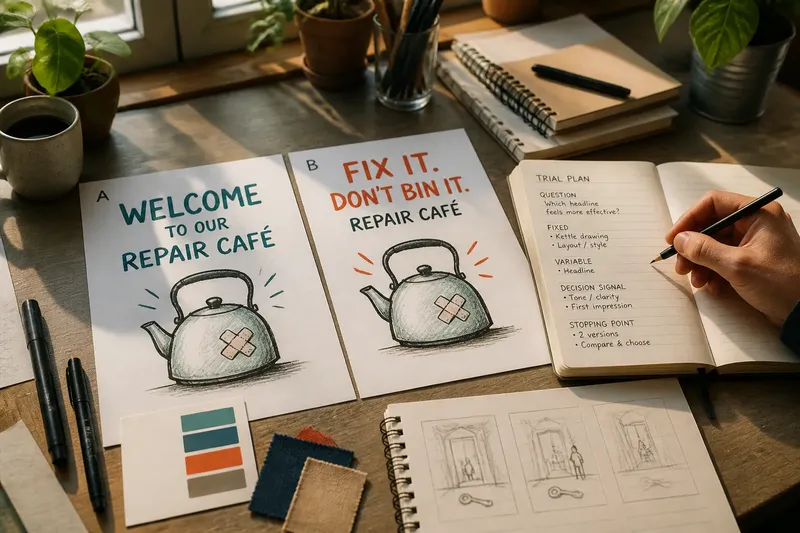
Say you want to make a poster for a local repair café, but you cannot decide whether it should feel welcoming or urgent. Rather than gather more inspiration or draft a complete design, choose one element that can distinguish those directions: the headline. Write two versions, place each above the same simple drawing of a mended kettle, and compare the tone. The result will not settle every design choice, but it can tell you which direction is more useful.
Tests, not predictions
A creative trial is a temporary version made to answer a specific question. It might be a rough chorus sung in two rhythms, a scene written with different narrators, or a paper model made from scrap card. The point is not to predict whether the finished work will succeed. It is to make a choice easier by giving you something concrete to compare.
Keep the question narrow enough that the trial can answer it. “Will this whole project work?” is too broad. “Does the scene feel tenser when the reader knows about the broken window?” gives you a clear variable to change and an effect to look for.
- Question: State one uncertainty in plain language. If it contains several separate decisions, split it into smaller questions; otherwise, keep it as the trial’s focus.
- Fixed elements: Name what will stay the same, such as the setting and characters. If the versions change many things at once, simplify them before comparing.
- Variable: Choose one element to alter, such as the narrator or headline. If you cannot identify one, define the question more tightly.
- Material: Pick a tool you already have, such as a notes app, pencil and paper, or free layout software such as Canva. If setup starts taking longer than the trial, switch to the simplest available tool.
- Decision signal: Decide what observable difference matters, such as a clearer image or a more natural spoken rhythm. If neither version shows that difference, revise the question rather than declaring a winner.
- Stopping point: Set a small boundary, such as two drafts or one paper mock-up. If the question remains unanswered at that point, change one aspect of the trial or park it; do not expand it into a full project by default.
Make one comparison
Changing one element at a time makes it easier to see what the change does. If you alter the subject, medium, audience and tone in the same attempt, a surprising result may be hard to explain. Keep the rest steady where practical, and treat the comparison as a prompt for judgement, not a verdict delivered by the material.
Imagine you are writing a short scene in which a caretaker finds a key. Your question is whether the scene feels more uneasy when the reader knows the key belongs to a locked room. Keep the characters, setting and sequence of actions the same. In version A, the key is simply described as brass; in version B, a line earlier establishes that the locked room has been off limits. Read both aloud. If version B makes the discovery feel charged without requiring extra explanation, keep that clue and draft the next section around it. If it makes the scene feel over-explained, remove the clue and try a different source of unease, such as the caretaker’s hesitation.
The comparison need not be formal. Put drafts side by side on paper, duplicate a file before editing, or record two melodies in a voice memo. Keep the versions labelled so you can tell what changed. If a difference is subtle, ask a trusted reader or listener one focused question instead of asking whether the whole piece is good.
Useful trial formats
Choose a format that matches the uncertainty. A writing question needs enough text to reveal voice or pacing; a visual question needs a viewable arrangement; a sound question needs something you can hear. The trial can remain rough as long as it exposes the feature you are trying to judge.
- Two openings: Draft the same scene with different first images. If one brings the reader into the action sooner, continue from it; if both feel remote, change the scene’s point of entry.
- Material swatch: Combine a small selection of colours, papers or textures on one sheet. If the combination supports the intended mood, use it as a palette; if it feels crowded, remove the element that competes most.
- Audio sketch: Record the same melody at two tempos using a phone voice memo. If one version carries the words more clearly, develop that pace; if neither does, revise the phrasing before recording again.
- Paper mock-up: Cut and fold scrap card to test a package or display shape. If it stands and opens as intended, refine the proportions; if it collapses or blocks access, alter the fold or structure.
- Audience swap: Explain an idea once to a friend who knows the subject and once to someone unfamiliar with it. If the unfamiliar listener cannot follow the central point, clarify the explanation; if the informed listener finds it too basic, add a more specific detail.
When a trial misleads?
How small should a creative trial be?
Make only enough to expose the choice you are weighing: a paragraph, a thumbnail sketch, or a short audio note may be sufficient. If you need substantial polishing before you can compare the options, reduce the scope or test a more visible feature.
What if both versions work?
Choose according to the purpose of the piece, or combine the strongest parts if they do not conflict. If you cannot name a meaningful difference, the decision may not matter yet, so move to a more consequential uncertainty.
What if neither version works?
Check whether the trial addressed the right question and whether its limits concealed what you needed to see. If the question was sound, change the variable or material; if the question itself feels irrelevant, set it aside and identify a more useful decision.
When should I stop testing?
Stop when the trial gives you enough reason to choose a next action, not when every doubt disappears. If repeated versions produce no new distinction, make a provisional choice and see what it allows you to build.
Keep the decision visible
After a trial, write down the decision and its reason in a sentence: “Keep the second headline because it names the repair service plainly.” That note prevents you from reopening the same choice without new information. If later work contradicts the reason, you can revise the decision deliberately rather than treating the first choice as permanent.
The myth of waiting for a perfect idea becomes less persuasive when a project is treated as a sequence of choices instead of a single leap. Choose one uncertainty, hold the other elements steady, and make the smallest version that lets you compare options. Keep the result only if it helps you decide what to do next; otherwise, change the question and try a different route.