A Window-Sill Noticing Hour for a Rainy Afternoon
A window-sill noticing hour turns a rainy afternoon into a small sound-and-light composition, with simple prompts for shaping what you hear and see.
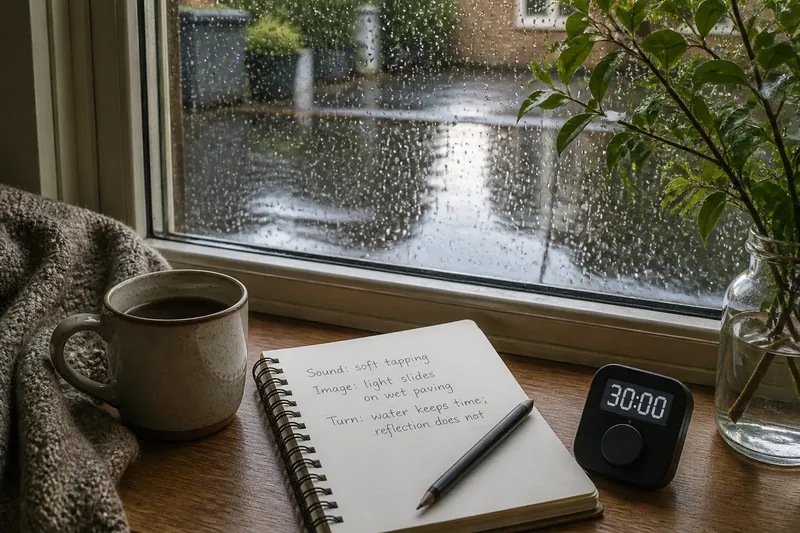
What can you make from rain tapping the glass, a chair and a blank page? A window-sill noticing hour can become a small sound-and-light composition: gather a few details from the weather, then arrange them into a short piece. You do not need to write well or finish anything polished.
Gather a few materials
Choose a comfortable place beside a window and bring a notebook, pencil and a kitchen timer or phone timer. Keep the window shut if opening it would be uncomfortable or unsafe. A warm drink is optional; the useful materials are a view, a place to write and a way to mark the end of your sitting.
Set a blank page aside for three kinds of material: sounds, changes in light and one brief phrase about the scene. This is not a record of everything outside. You are collecting ingredients for a small arrangement, much as you might gather colours before choosing where they belong.
Collect distinct ingredients
Listen first. Write down up to three sounds in plain language: “soft tapping”, “a low rush”, or “one drip, then silence”. If the room is quiet, write “no clear sound” rather than searching for one.
Next, look for a visual change or contrast. It might be a bright patch on wet paving, a reflection on the glass or a branch moving against a still wall. Record what is visible, not what you think it means.
Finish this gathering phase with one phrase that joins sound and sight. For instance, “thin tapping under a grey sky” puts two details beside each other without explaining them. Keep the phrase short; a compact ingredient is easier to rearrange than a paragraph.
Arrange a tiny composition
Use the notes to make a miniature piece with three lines. Put a sound in the first line, a visual detail in the second and a connection or contrast in the third. The lines can be prose, fragments or a simple list. Their job is to create a sequence, not to tell a full story.
- Sound: write one specific sound, or note that none stands out.
- Image: name one shape, colour or movement you can see.
- Turn: place the sound beside the image, or show how they differ.
Say you are sitting beside a kitchen window and hear a gutter drip while a pale reflection shifts across the pavement. Write “A drip repeats”, then “Light slides over the paving”, then “The water keeps time; the reflection does not.” The resulting piece links two observations through rhythm, without needing a character or plot.
Make choices from what you notice
- If two sounds overlap, note the nearer one first; if neither seems nearer, list them in the order you noticed them.
- If the view barely changes, choose a still shape and describe its edge; if that offers nothing, focus on the sound or the absence of one.
- If a phrase becomes abstract, replace it with a visible or audible detail; if you cannot verify the detail from your seat, leave it out.
- If reflections obscure the view, shift your sitting position slightly; if they remain, use the reflection itself as the image.
- If you collect more than three details, keep the ones that differ most in texture or movement; if two do the same job, set one aside.
- If the three lines feel disconnected, repeat a sound, colour or movement in the last line; if that feels forced, let the contrast stand without adding an explanation.
Questions about the ritual?
How long should the sitting last?
Choose an amount of time that fits your afternoon and set a timer if you want a clear stopping point. When it rings, finish the line you are writing or stop where you are; the page does not need to be complete.
What if there is no rain sound?
Use another sound from the room or street, such as a clock, distant traffic or a radiator. If nothing stands out, make silence the sound ingredient and build the piece around a visual detail.
Do I need to write poetry?
No. Three plain sentences or fragments are enough, and you can leave them as notes rather than shaping them into a poem. The arrangement is simply a way to put unlike details into relation.
Can I use a phone instead of a notebook?
Yes, but keep the screen dim and use a notes app with the display turned away between entries. If the phone pulls your attention from the window, switch to paper or hold the details in mind until the sitting ends.
Keep the page open
Read the three lines once and make one practical edit: remove a word that explains too much, or replace a vague description with a detail you can point to. Then stop. You can leave the page unfinished, circle a phrase to revisit or close the notebook without deciding what the piece means.
A window-sill noticing hour need not produce a finished poem to be useful. On another rainy afternoon, try a different arrangement: begin with the image, let a sound interrupt it, and end with the detail that remains. That small change gives familiar weather a new shape on the page.